Our recent work on light-matter interactions in time varying media is now published in Physical Review Letters. Congratulations Thomas and Jaime!
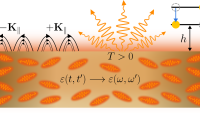
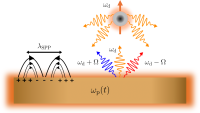
Any electromagnetic environment surrounding a source of light modifies how it may emit energy. A careful shaping of this environment can allow an increase, a decrease, or even the total suppression of the emission of light. Recent works have shown that when this environment is not static but is instead rapidly modulated in time, becoming a so-called time-varying media, even more surprising effects can happen. The emission can not only be enhanced or suppressed, but the modulated environment can directly transfer energy into the source, effectively converting it into a sink. This unique property, however, has been up to now constrained to a particular frequency and appeared only in a regime where the system is unstable, complicating its physical understanding and limiting its practical relevance. In this work, we show that these limitations can be overcome. We demonstrate through a realistic modelling of a time-varying media that a source embedded into it can absorb energy from the modulation in a broadband frequency window, and while the system stays in its stable regime. This opens exciting perspectives in the field of time-varying media. [Full Article]
Featured as IFIMAC Research Highlight.