Our recent work on light-matter interactions in time varying media is now published in Physical Review Letters. This time we consider an emitter near a time-modulated plasmonic slab and show how it can become an energy absorber. Congratulations Jaime and Thomas!
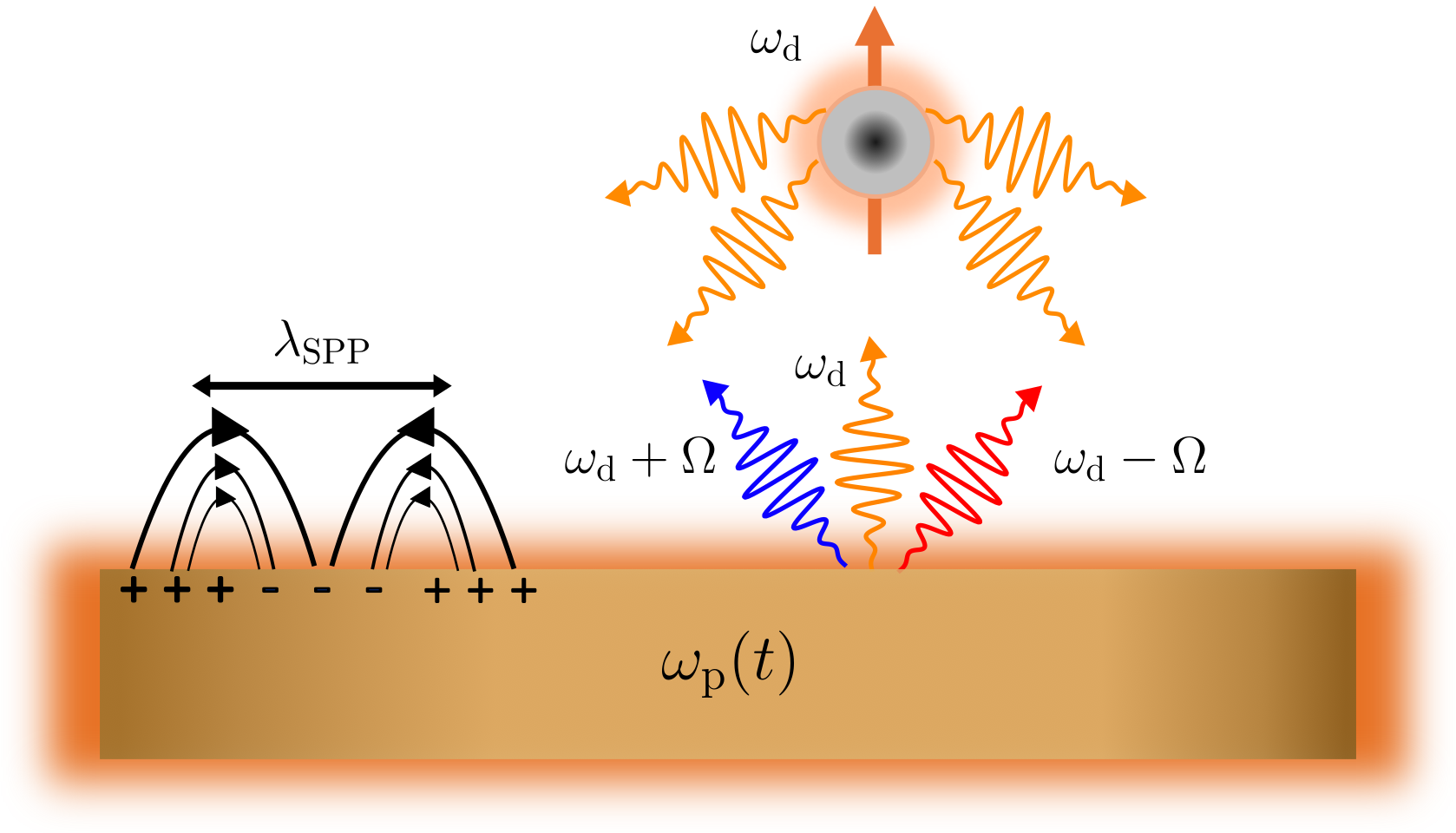
Light-matter interactions are enhanced in the presence of a plasmonic nanostructure. This enhancement stems from the existence of surface-waves (plasmons) sustained at the air-metal interface, which stimulate the emission of light by material sources close to the interface. In this work we show that when the plasmonic medium is modulated in time, the energy flow between light and matter is inverted: emitters no longer lose energy and instead, they gain it, with the surface-waves of the time-modulated plasma now stimulating energy absorption.
In recent years, experiments have shown that it is possible to modulate in time the properties of a material, enabling new phenomena not seen in static systems. However, most works neglect the dispersion of the time-modulated medium (i.e., the dynamics of its charges) and its confinement to a finite volume, both of which are necessary to provide a realistic description of light-matter interactions in any material.
In this work, we overcome these two limitations and consider a time-modulated plasmonic slab. We unveil new mechanisms to modify light-matter interactions. Firstly, there is near-field gain , through which the surface-waves of the time-modulated plasmonic slab stimulate energy-absorption by material sources close to the interface. On the other hand, through far-field control the plasmonic nanostructure behaves as an antenna and modifies light-matter interactions at large distances.