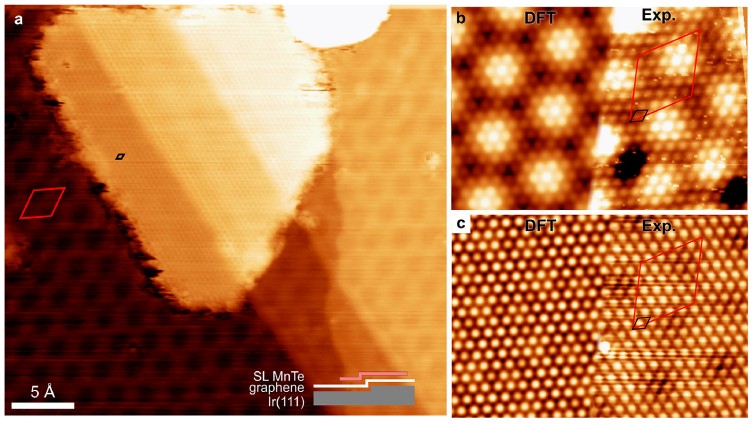
MnTe has recently emerged as a canonical altermagnet, a newly identified class of magnetism characterized by compensated antiferromagnetic order coexisting with spin-split electronic bands, traditionally considered exclusive to ferromagnets. However, the extent to which altermagnetism persists as altermagnets are thinned to the 2D limit remains largely unexplored. Here, the magnetic behavior of two-dimensional (2D) MnTe is investigated, specifically atomicallythin monolayers (MLs) and bilayers (BLs) grown on graphene/Ir(111) substrate, by combining experimental scanning tunneling microscopy, X-ray photoelectron microscopy, X-ray absorption spectroscopy, and X-ray magnetic circular dichroism with density functional theory calculations. It is found that while ML and BL MnTe adopt atomic structures with symmetries incompatible with altermagnetism, they exhibit intriguing magnetic phases: the BL forms a highly-robust layered antiferromagnet with in-plane spin anisotropy, whereas the ML presents characteristics compatible with spin-glass behavior below its freezing temperature, a phenomenon not previously observed in an atomically thin material. These findings highlight how reduced dimensionality can promote the emergence of unusualmagnetic structures distinct from those of their3D counterparts, providing new insights into low-dimensional magnetism.