
ALTMAG — Altermagnets: From theory to reality
ALTMAG brings together theory, computation and experiment to establish altermagnets as a materials platform for energy-efficient spintronics and optoelectronics. Developed under the M-ERA.NET Call 2025, the project is coordinated by Juan José Palacios at Universidad Autónoma de Madrid and has a planned duration of 36 months.
Project summary
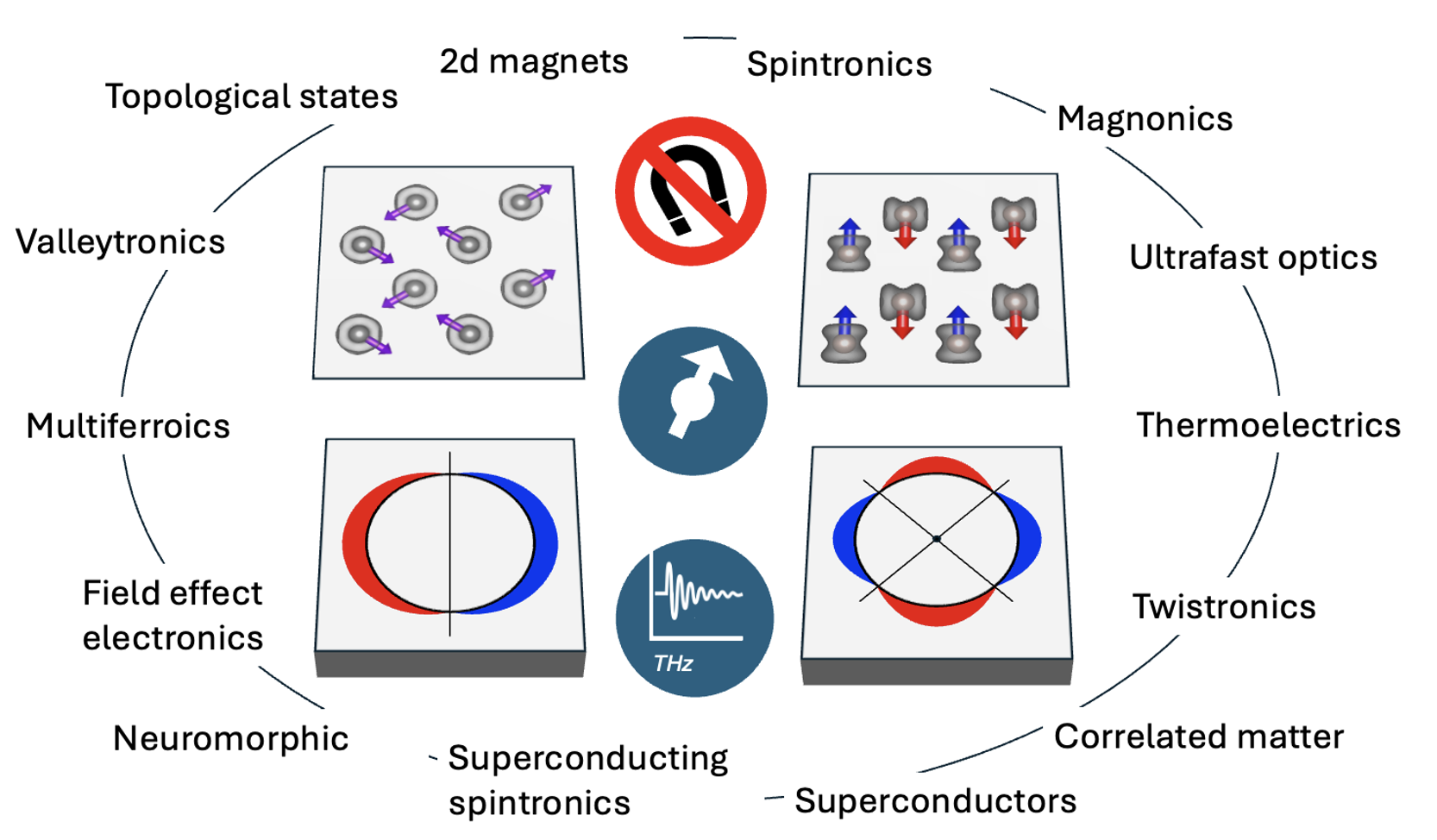
Altermagnets are a new class of magnetic materials that combine spin-split electronic structures, characteristic of ferromagnets, with zero net magnetization. This combination offers the prospect of devices without stray magnetic fields, compatibility with semiconductor technologies, and ultrafast spin dynamics at terahertz frequencies. However, turning these possibilities into practical technologies requires reliable knowledge of their electronic structure, experimental validation, and an understanding of their stability and sustainability.
ALTMAG addresses these challenges through three complementary objectives:
- Identify promising materials. Build a comprehensive catalogue of altermagnets using accurate electronic-structure calculations and predictions of optical and electronic responses, prioritising abundant, non-toxic and recyclable elements.
- Expand the discovery space. Explore non-collinear magnetic configurations, including p-wave magnets, topologically non-trivial electronic structures, and engineered heterostructures in which unconventional magnetic behaviour can emerge or be controlled.
- Move from predictions to demonstrators. Synthesise and characterise selected candidates, benchmark their properties, and investigate their integration into early proof-of-concept spintronic and optoelectronic devices.
Potential applications include spin-splitter elements for field-free spin-current generation, altermagnetic spin valves for logic and memory, bulk photovoltaic cells, and spin photodetectors. By linking materials discovery to experimental validation, ALTMAG aims to lay the foundations for faster, lower-power electronics and strengthen Europe’s capacity to develop sustainable information technologies.
Consortium and team
The consortium brings together six teams across Spain, France and Slovakia, represented by:
- Juan José Palacios — Universidad Autónoma de Madrid (UAM), Spain. Project coordinator; electronic, optical and transport response calculations.
- Maia García Vergniory — Donostia International Physics Center (DIPC), Spain. First-principles calculations and topological materials.
- Fèlix Casanova — CIC nanoGUNE, Spain. Spintronic and optoelectronic nanodevices and their experimental characterisation.
- Lisa Michez — CINaM–CNRS–AMUTech / Aix-Marseille Université, France. Growth and characterisation of altermagnetic thin films and heterostructures.
- Paul McClarty — CEA/CNRS, Laboratoire Léon Brillouin, France. Magnetic symmetries, phenomenological theory and symmetry-allowed responses.
- Martin Gmitra — Institute of Experimental Physics, Slovak Academy of Sciences (IEP SAS), Slovakia. Electronic structure, spin–orbit coupling and materials for spintronics.
Publications related to the project
- J. Mencos, A. Badura, E. Dolan et al. Time-reversal-symmetry-breaking spin injection from a compensated magnet. Nature 659, 69–75 (2026). DOI: 10.1038/s41586-026-11227-7.
- S. Chourasia, M. F. C. Martins Quintela and J. J. Palacios. Magnons and excitons from Bethe-Salpeter equation and its application to graphene-based magnets. arXiv:2610.32847 (2026), preprint.
Project contact: Juan José Palacios
